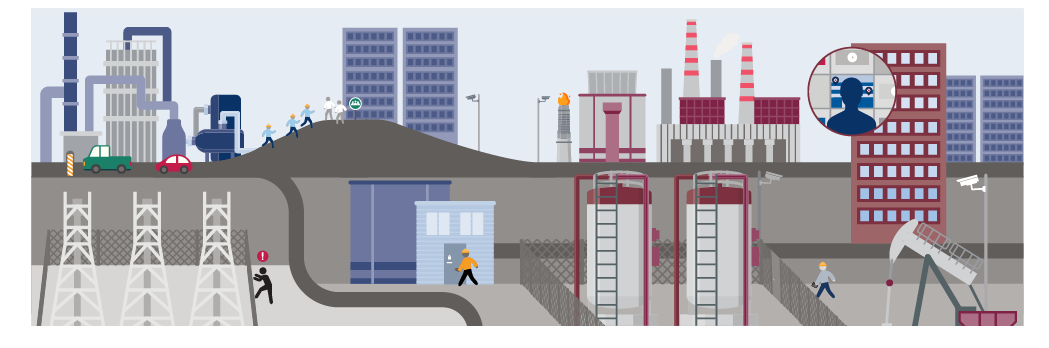
Energy and utility operators manage geographically distributed assets where physical security, operational continuity and safety are closely connected. Power plants, substations, renewable energy sites, pipelines and water facilities face different environmental and access challenges. A unified security architecture helps operators monitor remote locations, identify relevant events and coordinate response across critical infrastructure while integrating with appropriate operational systems.
l security, operational continuity and safety are closely connected. Power plants, substations, renewable energy sites, pipelines and water facilities face different environmental and access challenges. A unified security architecture helps operators monitor remote locations, identify relevant events and coordinate response across critical infrastructure while integrating with appropriate operational systems.
Protect critical infrastructure assets, including power plants, substations, renewable energy facilities, and water treatment facilities, with a unified physical security approach. Integrate video surveillance, access control, and perimeter protection to help safeguard sensitive areas and essential equipment.
Gain centralized visibility into geographically dispersed facilities, including remote substations, energy production sites, and utility infrastructure. Monitor live video, access events, and security alarms across multiple locations through a unified security platform.

Identify and respond to security events more effectively by bringing video surveillance, access control events, and alarm information together. Help security teams detect unusual activity, investigate incidents, and understand what happened across critical facilities. Configurable alerts and coordinated response workflows can support faster decision-making and more consistent incident handling.
Connect security systems with existing operational environments to support a more coordinated approach to facility management. Integrate video surveillance, access control, intrusion detection, and other compatible systems within a unified security architecture. Where appropriate, connections with operational systems and control-room workflows can help teams correlate security events with relevant site activities. SSDNET can support the design, integration, configuration, and commissioning of these solutions according to each facility’s technical requirements and operational procedures.
Energy and utility operators must secure critical sites, protect restricted operational areas, monitor perimeter risks and preserve continuity. IT and operational technology networks require carefully designed security boundaries.
Critical Site Security: Centralized video surveillance, access control, intrusion detection and security-event management for power plants, substations and utility facilities.
Thermal & Perimeter Surveillance: Fixed, panoramic and thermal cameras for suitable perimeter, equipment and facility-monitoring scenarios.
Restricted-Area Access Control: Credential-based access management for control rooms, substations, technical rooms and other sensitive zones.
Vehicle & Gate Management: License plate recognition and controlled vehicle access for plant entrances, service gates and restricted parking areas.
Fire & Emergency Protection: Fire detection, alarm, public announcement and voice-warning systems, with gas detection where required by the site’s hazard assessment.
Industrial IoT & Monitoring: Sensor integration and data visualization for selected environmental conditions and operational indicators.
AI-Based Safety Monitoring: Video analytics for selected unsafe behaviors and hazardous conditions where the deployment environment supports reliable detection.
Centralized Security Integration: Integration of compatible video, access, intrusion and alarm systems into a coordinated security operation.
Risk & Vulnerability Assessment: Physical security assessments and project planning for critical infrastructure protection.
Equipment & Personnel Safety: Location tracking, equipment visibility and proximity alerts for selected industrial workflows.
Network Segmentation: Firewall management, VLAN segmentation, secure remote access and network monitoring for enterprise and facility networks.
OT Cybersecurity: Unidirectional industrial security gateways and OT security assessments for suitable control-system environments.
Privacy Compliance: GDPR/KVKK personal data governance for employee, contractor and customer information where applicable.